Nurse Ratched
One Flew Over the Cuckoo's NestNurse Ratched is the ward’s most powerful administrator and the novel’s central embodiment of institutional control. In Chief Bromden’s account, her authority reaches beyond individual rules: it operates through schedules, surveillance, staff influence, and the power to define resistance as illness. Yet her control is not simply force. She can invoke the needs of vulnerable patients, defer proposals through procedure, and make discipline sound like care, turning the language of treatment into an instrument for preserving the order she commands.
Identity and Public Bearing
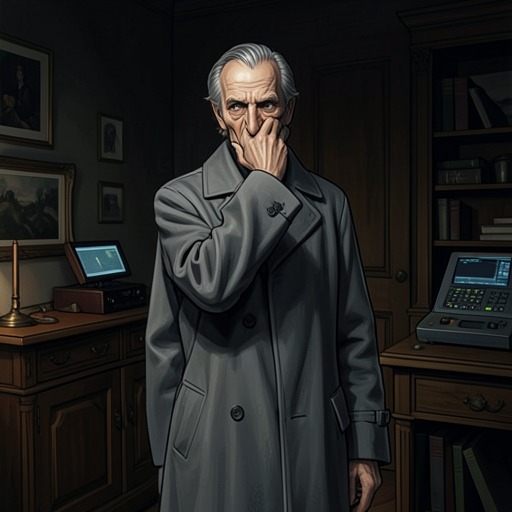
Chief Bromden first observes Nurse Ratched entering while he mops near the ward door. He recognizes her by the key’s familiar action in the lock; she slips inside, locks the door, and trails her fingers over the polished steel. Their orange color, matching her lips, strikes him as unnaturally hot or cold. The entrance establishes the character through small, controlled gestures: even the door and its lock seem to belong to a system she knows intimately.
Her woven wicker bag resembles those sold by the Umpqua tribe along the highway, but Bromden sees no ordinary personal effects inside it. The loose weave reveals what he imagines as a portable inventory of institutional work: gears, wheels, pills, needles, forceps, pliers, and copper wire. She has carried it for as long as he has known her. When she nods to him, he presses himself back with the mop and hides his eyes, hoping she cannot read him. The bag thus joins domestic appearance to machinery and medical instruments, while Bromden’s concealed gaze shows how thoroughly her presence shapes patients’ behavior.
Her face, as Bromden describes it, is smooth and carefully coordinated, with enamel-like skin and baby-blue eyes. He sees a mismatch between that manufactured doll-like appearance and her large breasts, and interprets the contrast as a source of bitterness for her. This is Bromden’s reading rather than an independent account of her inner life; his narration repeatedly renders Nurse Ratched through the machinery and threat he perceives around her. The composed public surface and the tension he believes lies beneath it are central to that portrayal.
Methods of Ward Control
Nurse Ratched’s governing ideal is adjustment. Bromden describes her as intolerant of anything messy, obstructive, or out of place: disorder tightens her into what he imagines as a small knot of fury, though she retains her calm smile and measured manner. He says she does not relax until the nuisance has been adjusted to its surroundings. The contrast between her controlled appearance and the pressure behind it makes routine administration feel like a campaign to eliminate whatever cannot be fitted into the ward’s design.
That campaign extends, in Bromden’s vision, beyond the ward. Nurse Ratched must spend time Outside, but she works alongside the Combine, which he understands as a vast organization devoted to adjusting the wider world as well as the institution. He portrays her accumulated experience as a network of nearly invisible wires: she sits at its center like a watchful robot, tending each connection with the precision of an insect and knowing which current to send where. Bromden connects this image to his own training as an electrician’s assistant in Army camp and to electronics he studied in college. The metaphor is therefore not only a description of her influence but a way of showing how he has learned to perceive power as a hidden system of connections.
The order she seeks resembles a pocket watch with a glass back: precise, visible, and governed by an unbreakable schedule. In its most extreme form, Bromden imagines that all patients who are not Outside would become wheelchair-bound Chronics, their catheter tubes running to the sewer beneath the floor. He also depicts her managing staff through attrition. Doctors arrive with their own ideas about the ward; she fixes them with what he calls dry-ice eyes until, in his account, they retreat, chilled and uncertain. The image makes her authority larger than any single confrontation: it operates by wearing down alternatives until the institution’s routines appear unavoidable.
Surveillance and the Classification of Resistance
Nurse Ratched treats Randle Patrick McMurphy’s arrival as a threat to that routine. While preparing hypodermic needles in the glass Station, she tells a junior nurse that he plans to take over and classifies him as a manipulator who uses people and circumstances for his own ends. She lists possible motives including comfort, power, respect, monetary gain, or disruption for its own sake, and recalls Maxwell Taber as a previous ward manipulator. Her explanation presents disruptive conduct not as a disagreement over how the ward should work, but as a recognizable type of patient behavior that staff must contain.
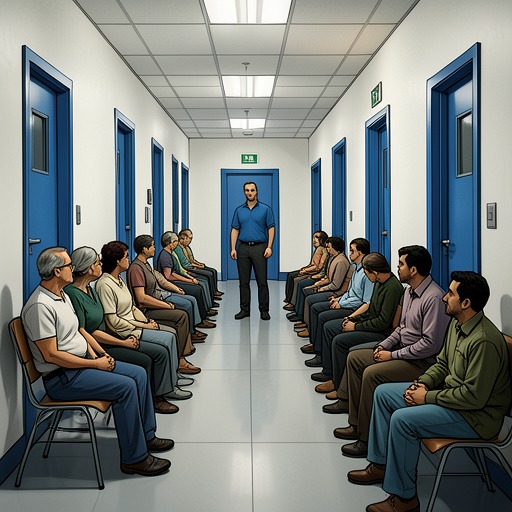
Her surveillance is particularly visible when Dale Harding challenges McMurphy to consider whether he can prevail against her. From behind the glass, Nurse Ratched has a tape recorder hidden out of sight and is already recording the exchange for possible use in the schedule. When the patients notice her watching, she nods; their attention turns away from her and back to McMurphy, who recognizes that he has been put on the spot. The scene shows how observation itself can shape a confrontation: she need not interrupt to make her presence consequential.
The same power appears in her response to the prospect of sending McMurphy to the Disturbed Ward. A staff member proposes transfer, but Nurse Ratched rejects the idea that this would solve the problem, describing it as passing the difficulty to another ward. She also resists treating him as an extraordinary or super-psychopathic case. Her refusal complicates a simple portrait of reflexive punishment: she insists that the ward retain responsibility for handling him, rather than letting another institution absorb the challenge. In context, that position keeps the conflict within her administrative domain.
Procedure, Persuasion, and Discipline
Nurse Ratched’s authority works through ostensibly reasonable appeals as well as explicit rules. When McMurphy wants the loudspeaker turned down, she reminds him that other patients depend on it: some cannot hear the radio if its volume is lower, while others cannot read, work puzzles, or play cards to win cigarettes. She names older patients, including Colonel Matterson and Kittling, for whom the music is all they have. Her appeal makes him acknowledge that he had not considered the Chronic side. The argument is effective because it draws on a genuine difference among patients, even as she uses that difference to oppose his request and address the listening Acutes as well as him.
She also neutralizes a proposed ward carnival without openly condemning it. After Dr. Spivey describes games, booths, and ticket sales, Nurse Ratched allows that the idea might have therapeutic possibilities, then insists that it be discussed at a staff meeting before a decision. Her pause leaves the room waiting for an objection; when none comes, she turns the proposal back toward procedure. The plans stop there. The exchange displays a characteristic form of control: an idea can be acknowledged, even granted a therapeutic rationale, and still be prevented from becoming action.
The ward vote over television demonstrates how procedure can determine what counts as a decision. Nurse Ratched declares the vote defeated because only twenty of the ward’s forty patients voted, and she says a majority is required to change policy. When McMurphy protests that the meeting has been unfair, she does not debate his charge; she asks Dr. Spivey to note that he seems upset and suggests ending the meeting early in view of his condition. A dispute over the meaning of a vote is thus redirected toward the patient’s emotional state. The rule closes the matter, while the clinical framing makes his protest itself part of the case against him.
Her defense of discipline follows the same pattern on a broader scale. Three weeks after the patients’ conduct concerning house duties, she tells them that the staff has considered punishment and waited for an apology, but none has shown remorse. She presents the rules as therapeutically valuable and argues that some patients became ill because they failed to adjust to rules in the outside world. In her account, parental lenience may have allowed that failure to grow into illness; enforcing order is therefore for the patients’ own good. By making conformity both the standard and the proposed cure, she gives institutional discipline a moral and medical justification at once.
Conflict and Narrative Significance
Nurse Ratched’s power is most consequential where patients’ choices are constrained by their status and the ward’s procedures. After learning more about the risks of antagonizing her, McMurphy tells the others he has discovered why they defer to her and that he does not want to provoke her into adding time to his sentence. Dale Harding explains that he is voluntary, whereas McMurphy is committed; he also clarifies that only a few patients are committed. McMurphy’s alarmed demand to know whether the others have been misleading him marks a shift in his understanding of the contest. Nurse Ratched does not need to issue a new threat in that exchange: the difference between voluntary and involuntary status has already made the stakes of resistance unequal.
Her character is therefore defined not only by the force she can apply but by her ability to make power appear procedural, therapeutic, or necessary for other patients. Bromden’s imagery of locks, instruments, wires, schedules, and machinery translates her authority into a system that reaches from a single room to the world outside it. Against that system, McMurphy’s challenge is not merely a clash of personalities. It exposes how care, classification, and rules can work together to narrow the space in which patients may act—and how a protest can be absorbed into the very diagnosis it contests.